Plural nouns
Regular and irregular plurals.
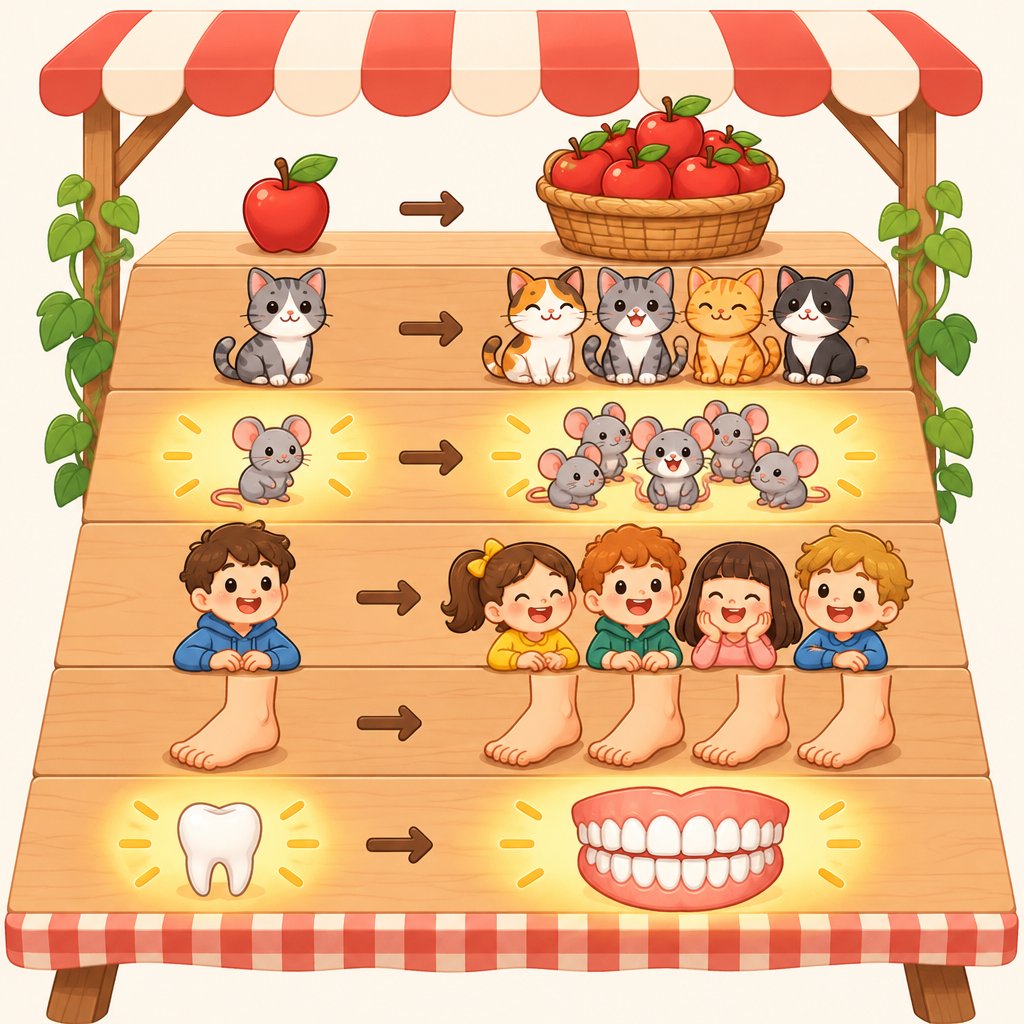
A plural noun means more than one person, animal, thing or idea. Most nouns just add -s (book → books), but some change in other ways (child → children).
When to use it
- To talk about more than one thing. Use a plural noun after numbers bigger than one. - I have two brothers and three sisters. - She bought five apples.
- After words like many, some, a lot of, these, those. - There are many students in the class. - Can you give me those boxes?
- To talk about things in general. Use the plural with no a or the. - Cats are clever animals. - I love tomatoes.
How to form it
Regular plurals: spelling rules
| Singular ending | Rule | Examples |
|---|---|---|
| Most nouns | add -s | book → books, car → cars |
| -s, -ss, -sh, -ch, -x, -z | add -es | bus → buses, class → classes, dish → dishes, watch → watches, box → boxes |
| consonant + -y | change y to -ies | city → cities, baby → babies |
| vowel + -y | add -s | day → days, key → keys, boy → boys |
| -f / -fe (many words) | change to -ves | knife → knives, leaf → leaves, wife → wives, half → halves |
| -o (some words) | add -es | potato → potatoes, tomato → tomatoes, hero → heroes |
Be careful: some words do not follow the -f and -o rules: roof → roofs, chef → chefs, belief → beliefs, photo → photos, piano → pianos, radio → radios.
Irregular plurals
| Singular | Plural |
|---|---|
| man | men |
| woman | women |
| child | children |
| person | people |
| foot | feet |
| tooth | teeth |
| mouse | mice |
Same in singular and plural
one sheep → two sheep, one fish → ten fish, one deer → three deer, one series → two series
Always plural
Some nouns are only plural and take a plural verb: trousers, jeans, glasses, scissors, clothes, police. - My jeans are new. / The police are here.
Pronunciation of -s / -es
- /s/ after sounds like p, t, k, f: cups, cats, books
- /z/ after most other sounds: dogs, days, cars
- /ɪz/ (an extra syllable) after s, z, sh, ch, j sounds: buses, watches, pages
Common mistakes
- ✗ I have three child. → ✓ I have three children. After a number bigger than one, use the plural. Child is irregular.
- ✗ There are many peoples in the shop. → ✓ There are many people in the shop. People is already the plural of person.
- ✗ Two citys are on the map. → ✓ Two cities are on the map. Consonant + y changes to -ies.
- ✗ She gave me some good advices. → ✓ She gave me some good advice. Advice is uncountable, so it has no plural.
- ✗ He is a ten-years-old boy. → ✓ He is a ten-year-old boy. When a number + noun comes before another noun, the noun stays singular.
Compare
Countable vs. uncountable nouns
Only countable nouns have a plural form. Uncountable nouns have no plural and use a singular verb.
| Countable (has a plural) | Uncountable (no plural) |
|---|---|
| a suitcase → two suitcases | luggage |
| a chair → some chairs | furniture |
| a fact → many facts | information |
| a job → three jobs | work |
- I have two suitcases. ✓but I have a lot of luggage. ✓(not luggages)
- The news is good. ✓(news ends in -s but is uncountable and singular)
To count uncountable nouns, use words like a piece of: two pieces of advice, a piece of furniture.
Quick tips
- After a number bigger than one, always check: is my noun plural?
- Learn irregular plurals in pairs: man–men, foot–feet, child–children.
- In writing exams, check spelling with -y, -f and -o endings. These are common errors.
- Don't add -s to information, advice, furniture, luggage, news or equipment.