Reflexive pronouns
myself, yourself, each other.
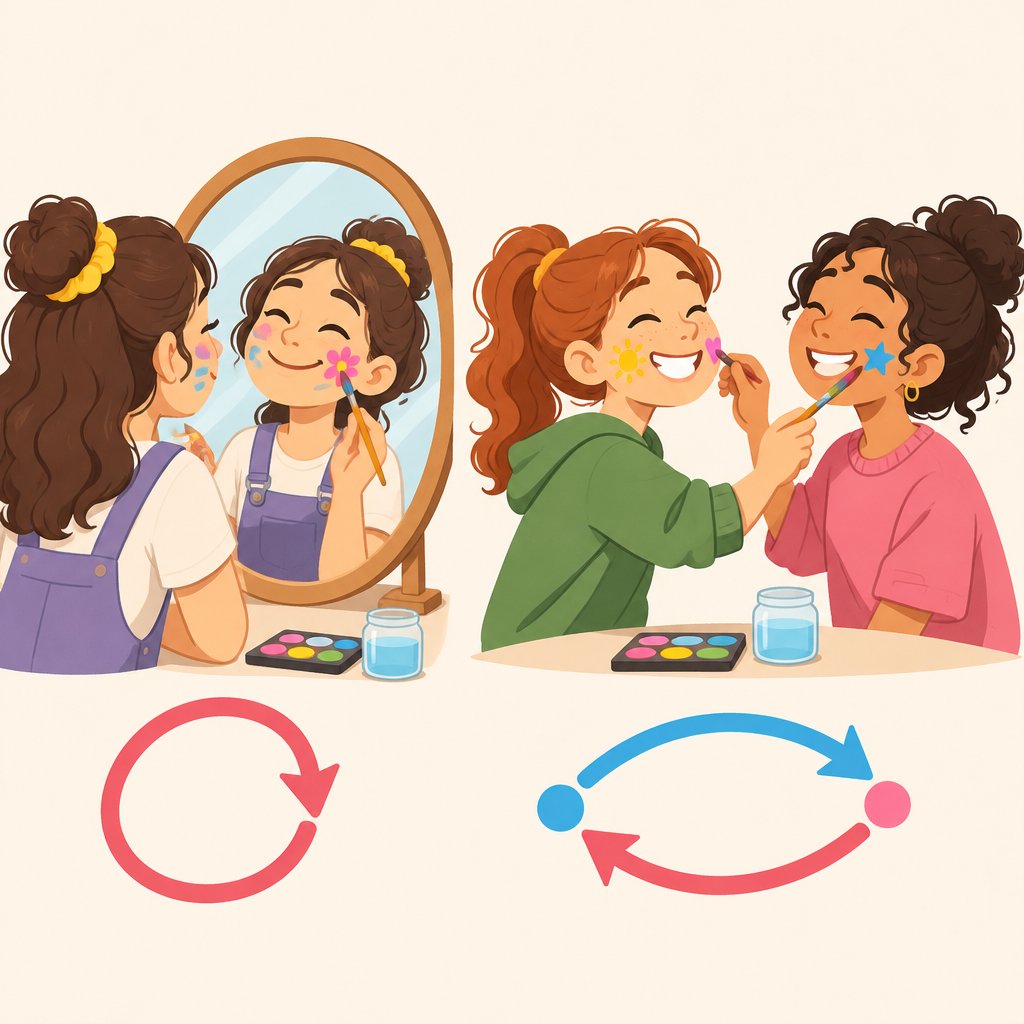
Reflexive pronouns are words like myself, yourself and themselves. We use them when the subject and the object of a sentence are the same person or thing. In this lesson you will also learn each other, which is often confused with reflexive pronouns.
When to use it
1. The subject does the action to itself. I cut myself while I was cooking. She taught herself to play the guitar.
2. After a preposition, when it refers back to the subject. He is always talking about himself. Take care of yourselves!
3. For emphasis (to show that this person, and nobody else, did it). The manager herself called me. We painted the house ourselves.
4. With by to mean 'alone' or 'without help'. My grandmother lives by herself. Did you fix the car by yourself?
5. In some fixed expressions. Enjoy yourself at the party! / Help yourself to coffee. / Make yourself at home. / Behave yourselves!
How to form it
| Subject pronoun | Reflexive pronoun |
|---|---|
| I | myself |
| you (one person) | yourself |
| he | himself |
| she | herself |
| it | itself |
| we | ourselves |
| you (more than one) | yourselves |
| they | themselves |
| one | oneself |
Note: singular forms end in -self; plural forms end in -selves. When they refers to one person whose gender is unknown, most people use themselves (some also use themself): Someone has hurt themselves.
Common mistakes
✗ Myself and Tom will lead the meeting. → ✓ Tom and I will lead the meeting. A reflexive pronoun cannot be the subject of a sentence. This mistake is common in formal emails.
✗ Please send the report to myself. → ✓ Please send the report to me. Use myself only when I is also the subject: I sent the report to myself.
✗ I need to relax myself after work. → ✓ I need to relax after work. Some verbs are not reflexive in English, even if they are in your language: relax, feel, concentrate, meet, wake up, get up, worry. With wash, shave and dress we usually leave it out too: I got dressed and left.
✗ He hurt hisself playing football. → ✓ He hurt himself playing football. Hisself and theirselves are not standard English. Use himself and themselves.
✗ Did you enjoy at the concert? → ✓ Did you enjoy yourself at the concert? Enjoy needs an object. If there is no other object, use a reflexive pronoun.
Compare
Reflexive pronoun vs. each other
Each other (also one another) shows that two or more people do the same action to the other person. A reflexive pronoun shows that each person does the action to himself or herself.
Anna and Ben looked at themselves in the mirror. (Anna looked at Anna; Ben looked at Ben.) Anna and Ben looked at each other. (Anna looked at Ben; Ben looked at Anna.)
You can also make each other possessive: They often borrow each other's clothes.
Remember: meet, marry, kiss and fight usually need no object at all when the meaning is clear: We met in 2015. / They got married last year.
Higher-level point: place prepositions. After prepositions of place, we normally use an object pronoun, not a reflexive one: She put her bag next to her. / He closed the door behind him. But when the meaning would be unclear or there is special focus, the reflexive is used: She was beside herself with worry. (= very upset — a fixed expression)
Quick tips
- Ask yourself: is the object the same person as the subject? If yes, use a reflexive pronoun. If no, use me, him, them, etc.
- Never start a sentence with Myself and... — it sounds wrong to native speakers and examiners.
- Two people doing the action to the other person = each other, not themselves.
- Learn fixed phrases as chunks: help yourself, make yourself at home, by myself, enjoy yourself.