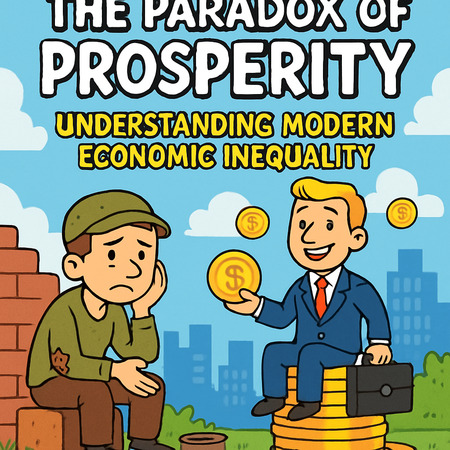
The Paradox of Prosperity: Understanding Modern Economic Inequality
The contemporary global economy presents a fascinating paradox that challenges conventional wisdom about development and progress. Despite unprecedented technological advancement, record-breaking productivity metrics, and the proliferation of wealth creation mechanisms, economic inequality has reached historically troubling levels across developed nations. This phenomenon demands nuanced examination, as surface-level interpretations frequently obscure the intricate mechanisms perpetuating disparity.
Traditional economic theory posits that technological innovation should democratize opportunity and distribute prosperity equitably. The logic appears sound: automation reduces production costs, increased efficiency generates surplus capital, and competitive markets theoretically compel companies to pass savings to consumers. Yet empirical evidence reveals a starkly different reality. The gains from technological advancement have accrued disproportionately to capital owners and highly specialized workers, while the middle-income cohort has experienced stagnation. This divergence reflects structural transformations in labour markets that merit careful consideration.
The rise of the "superstar economy" exemplifies this transformation. Digital platforms create winner-take-all markets where exceptional talent commands astronomical compensation while competent professionals earn subsistence wages. Consider how a software engineer at a leading technology firm might earn fifty times the salary of an equally capable peer at a regional company. This disparity stems not merely from individual merit but from network effects, information asymmetries, and institutional structures that concentrate opportunities among elite networks.
Simultaneously, globalization has fundamentally restructured wage dynamics in developed economies. Manufacturing outsourcing to lower-cost jurisdictions has decimated middle-income employment in industrialized nations, while investment capital flows to jurisdictions offering optimal regulatory conditions and tax incentives. Multinational corporations engage in sophisticated tax optimization strategies, effectively reducing their fiscal contributions to the societies where they generate substantial revenue. This legal yet morally ambiguous practice diverts resources from public investment, creating second-order effects that compound inequality.
Capital accumulation presents another critical dimension. Wealth begets wealth through various mechanisms: inherited assets provide compounding advantages, property ownership generates rental income insulated from labour markets, and diversified investment portfolios capture returns unavailable to wage earners. The wealthy increasingly derive income from capital appreciation rather than labour compensation, creating fundamentally distinct economic trajectories based on initial endowments rather than effort or ingenuity.
Financial innovation has further complicated the landscape. Derivatives, algorithmic trading, and sophisticated hedging strategies generate substantial returns for those with capital and expertise to access these instruments. Meanwhile, unsophisticated retail investors frequently bear the externalized risks of these activities, as evidenced by recurring financial crises precipitated by excessive leverage and inadequate regulatory oversight. The socialization of losses through taxpayer-funded bailouts while profits remain privatized represents a fundamental market failure that perpetuates inequality.
Education, ostensibly the primary mechanism for intergenerational mobility, increasingly stratifies rather than equalizes opportunity. Elite institutions produce networks that confer advantages extending far beyond credential acquisition, while underfunded public education systems in lower-income communities fail to develop human capital adequately. Student debt, meanwhile, impedes wealth accumulation for emerging professionals, creating delayed economic participation and diminished lifetime earnings relative to previous generations.
Policy responses prove inadequate partly because they frequently address symptoms rather than structural causes. Progressive taxation, while superficially appealing, encounters sophisticated avoidance strategies available exclusively to substantial wealth holders. Regulatory interventions often prove ineffective against well-resourced actors capable of exploiting regulatory interstices. Furthermore, political economies increasingly reflect the preferences of wealthy constituencies, as campaign finance mechanisms translate economic power into political influence.
Yet neither determinism nor cynicism proves warranted. Emerging economic models emphasizing stakeholder capitalism, universal basic income, and reformed taxation present potential pathways toward more equitable distribution without sacrificing dynamism. The fundamental question persists: whether contemporary societies possess sufficient collective will to restructure institutions reflecting different distributional priorities. This challenge transcends mere economics, implicating foundational questions about social cohesion, meritocratic legitimacy, and collective flourishing.