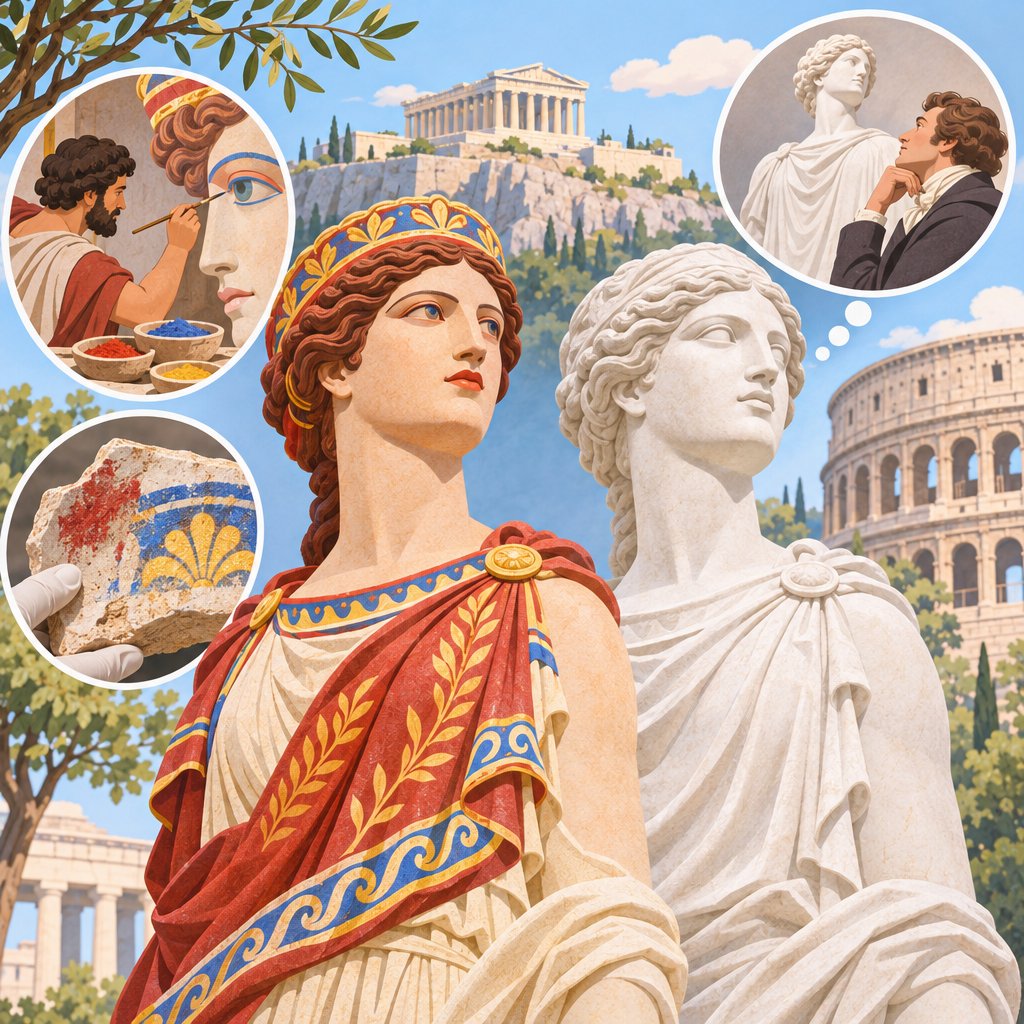
The Colour the Marble Lost
For centuries, visitors to museums have walked among pale marble figures and assumed they were seeing the classical world as it truly appeared: austere, luminous, and untouched by vulgar ornament. The image of the bleached Greek statue has become so deeply embedded in the Western imagination that it is rarely questioned. Yet the marbles that survive are, in a sense, the remnants of a long process of loss. Pigments are fragile, and most were applied with binders that could not withstand burial, weathering, or the well-meaning scrubbing of later restorers. What remains is often a ghost of the original, and the absence of colour has been mistaken for its intention.
The suspicion that Greek and Roman sculpture was once brightly painted is hardly new. Early excavators in Athens and Rome reported flecks of pigment clinging to stone, and some of them were visibly unsettled by what they saw. Many preferred to treat colour as a later, perhaps decadent, addition that had nothing to do with the sculptor's original vision. The white ideal, in other words, was not simply a neutral reading of the evidence. It reflected the aesthetic convictions of an age that regarded purity of form as the highest expression of classical virtue, and it lent those convictions an air of historical authority.
What has changed in recent decades is the technology available to scholars. Ultraviolet fluorescence, X-ray analysis and microscopic examination of tiny residues have allowed researchers to identify specific substances, among them Egyptian blue, ochres and malachite green, and to map where they were applied. Some of these findings are unambiguous: a pigment is either present or it is not. Others are far more tentative. A trace of red on a garment's hem may indicate a painted pattern, a secondary layer, or simply a contaminant deposited in the soil over two thousand years. Interpreting such fragments requires a degree of caution that popular accounts often abandon.
The reconstructions that have toured museums in Europe and North America have been striking, and in some cases almost garish. Faces are flushed, robes are patterned in saturated reds and blues, and eyes are rendered with a startling directness. Supporters argue that these images restore to the ancient viewer an experience that the white marble has erased, and that the vivid versions were probably intended to be read quickly, from a distance, in bright sunlight. Critics, however, question whether the reconstructions reveal the past or merely reveal the tastes of the people who made them. Because the pigments are often known only from scattered patches, the final appearance of a statue depends heavily on assumptions about design that cannot be verified. A plausible guess can quickly harden into a confident illustration, and the caveats tend to vanish along the way.
The debate, then, is not simply a contest between truth and myth. It is also a question of how much certainty the evidence can bear, and of why certain certainties have proved so durable. The whiteness of antiquity was once celebrated as proof of refinement, and it was occasionally pressed into service in arguments about racial hierarchy and cultural superiority, a history that makes many people uneasy about the new consensus. Yet a more accurate picture of the ancient world does not require a wholesale replacement of one fantasy with another. Perhaps the most valuable lesson is that the bare stone was itself a choice, made by later generations who saw in the absence of colour something they wished to admire. Recognising that choice may be more instructive than any single reconstruction, however dazzling it looks in a gallery.