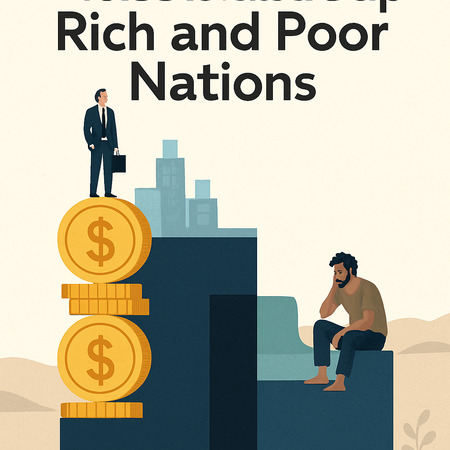
The Growing Gap Between Rich and Poor Nations
Inequality has become one of the most pressing challenges of our contemporary world, manifesting itself not only within societies but also between nations on an increasingly dramatic scale. While technological advancement and globalization have promised to bridge divides, the reality painted by statistics suggests otherwise. The wealth accumulated by the richest individuals has reached staggering proportions, whereas millions continue to struggle with poverty, inadequate healthcare, and limited educational opportunities.
The mechanisms through which inequality is perpetuated are complex and deeply embedded in historical, political, and economic structures. Colonial legacies have left developing nations disadvantaged, their resources extracted and their populations left without adequate infrastructure or investment. Furthermore, contemporary trade agreements, though presented as mutually beneficial, often favour wealthy nations whose corporations possess greater bargaining power. Educational disparities serve as another critical factor; children born into affluent families are systematically exposed to superior schooling, thereby securing competitive advantages that persist throughout their lives.
The consequences of unchecked inequality extend far beyond mere financial hardship. Social cohesion deteriorates when citizens perceive the system as fundamentally unjust, leading to increased crime rates, mental health challenges, and political instability. When opportunity is dictated by circumstance of birth rather than merit and ambition, the entire concept of meritocracy becomes hollow. Societies become fragmented, with the wealthy insulating themselves in gated communities while the poor are confined to deteriorating neighbourhoods lacking basic services.
However, inequality is not an inevitable condition that must be passively accepted. Several nations have demonstrated that strategic interventions can substantially reduce the wealth gap. Progressive taxation systems, wherein higher earners contribute proportionally more, generate revenue for universal healthcare and education. Microfinance initiatives have empowered entrepreneurs in developing regions, enabling them to establish businesses without relying on traditional banking systems controlled by established elites. Furthermore, international cooperation through organizations dedicated to sustainable development has facilitated knowledge transfer and technological advancement in poorer nations.
The path forward requires acknowledging that inequality diminishes everyone's potential for flourishing. When talent remains undiscovered because of poverty, when innovation is stifled by lack of resources, and when social potential is wasted, entire societies suffer losses they can scarcely comprehend. Addressing inequality demands multifaceted approaches: reforming educational systems to ensure equitable access, implementing fair labour practices, strengthening governance to prevent corruption, and fostering genuine international partnerships.
Moreover, younger generations increasingly recognize that their futures are inextricably linked to global stability and equity. Climate change, pandemic diseases, and mass migration—challenges spawned partly by inequality—affect wealthy and poor nations alike. This recognition may catalyze the collective will necessary for transformative change. While constructing a more equitable world remains extraordinarily challenging, the consequences of inaction suggest that attempting meaningful reform is humanity's most rational choice. The question is not whether inequality can be addressed, but whether we possess the courage and commitment to do so before it fractures our world irreparably.