The Paradox of Social Media and Modern Stratification
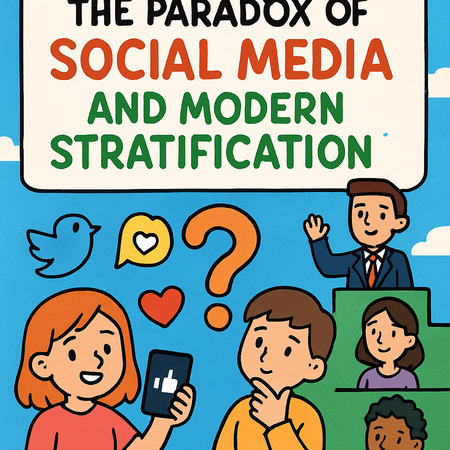
The advent of digital communication technologies has fundamentally reconfigured how sociologists conceptualize social stratification, challenging classical theoretical frameworks whilst simultaneously reproducing age-old hierarchies in unprecedented ways. What was once envisioned as a democratizing force—enabling unprecedented horizontal connectivity and ostensibly dismantling traditional gatekeepers of information and cultural capital—has instead revealed itself as a complex arena where power dynamics manifest with remarkable subtlety and sophistication.
Consider the phenomenon of 'algorithmic sorting,' wherein sophisticated computational systems determine which content reaches whom, effectively reconstructing the class divisions of industrial societies within digital space. Unlike the transparent mechanisms of occupational prestige or educational credentials that Max Weber identified, these algorithmic determinations operate with such opacity that even their architects struggle to articulate their precise mechanisms. This obfuscation itself becomes a form of power—what Pierre Bourdieu might recognize as a contemporary manifestation of cultural capital, except now mediated through mathematical abstraction rather than inherited sophistication.
The irony deepens when we examine influencer culture, a phenomenon that ostensibly represents meritocratic ascension wherein charisma and relatability supersede traditional markers of status. Yet empirical research reveals that disproportionate visibility clusters among individuals already possessing economic resources—those capable of investing in optimal lighting, editing software, and aesthetic curation. The appearance of accessibility thereby masks the persistence of structural advantage. A teenager from an affluent suburb, blessed with leisure time and financial resources for presentation, accumulates symbolic capital whilst their equally talented counterpart in economically disadvantaged circumstances remains algorithmically invisible.
Moreover, the concept of 'network capital' has emerged as perhaps the most consequential contemporary form of inequality. Sociologists increasingly recognize that one's position within social networks—who knows whom, who trusts whom—often determines life outcomes with greater precision than traditional variables. Employment, investment opportunities, and even romantic partnerships increasingly flow through intimate networks rather than formal institutions. The digital sphere has simultaneously expanded these networks exponentially whilst concentrating access within particular communities. This creates what sociologists term 'homophily'—the tendency of individuals to associate with similar others—which paradoxically intensifies despite technological promises of boundless connection.
The phenomenon of 'digital divide 2.0' further complicates conventional narratives of technological democratization. While internet access has expanded dramatically in developed nations, meaningful participation—the capacity to leverage digital platforms for economic or social advancement—remains stratified along familiar lines of class, race, and geography. A digital presence requires not merely access to devices and connectivity, but sophisticated understanding of algorithmic logic, aesthetic conventions, and platform-specific norms. This tacit knowledge, often acquired through family socialization and peer exposure, remains unevenly distributed, thereby perpetuating what Bourdieu identified as social reproduction—the mechanism through which privilege replicates itself across generations.
Yet the picture remains more nuanced still. Sociologists must acknowledge instances wherein digital platforms have genuinely enabled subordinated groups to mobilize collectively, challenge entrenched narratives, and articulate previously marginalized perspectives. The #MeToo movement, climate activism, and decolonial intellectual projects have leveraged social media in ways that conventional gatekeepers could not suppress or control. These counterexamples suggest that technological systems remain sites of contestation rather than predetermined instruments of domination.
The sociological challenge, then, involves resisting both techno-utopianism—the naive belief that technology inherently produces liberation—and technological determinism, which suggests that platforms inevitably reproduce existing power structures. Instead, we must examine how specific social actors navigate, manipulate, and sometimes subvert these systems within broader structural constraints. Digital space represents neither utopia nor dystopia but rather a contested terrain wherein human agency and structural determination continuously interact.
Understanding contemporary society requires grappling with these complexities, recognizing that democratization and stratification proceed simultaneously, often indistinguishably. The sociological imagination demands that we interrogate the contradictions inherent in systems promising connection while engineering isolation, meritocracy while reproducing privilege, and agency while constraining genuine autonomy.