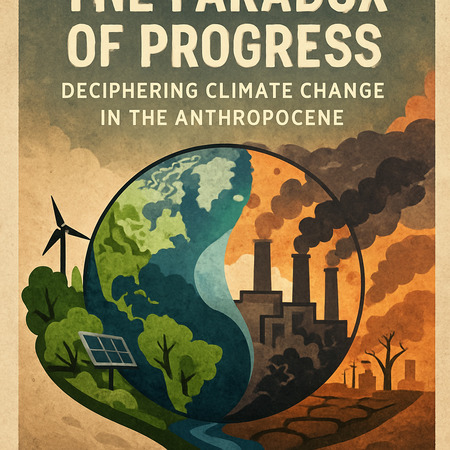
The Paradox of Progress: Deciphering Climate Change in the Anthropocene
The discourse surrounding climate change has fundamentally transformed from peripheral scientific inquiry into a central geopolitical and economic preoccupation. Yet paradoxically, despite unprecedented accumulation of empirical evidence and technological sophistication, humanity remains ensnared in what might be termed a productive stalemate—simultaneously acknowledging existential threats whilst perpetuating the very mechanisms that exacerbate environmental degradation.
The crux of this contradiction lies in our contemporary civilization's structural dependency on carbon-intensive infrastructure. Developed economies have constructed intricate webs of industrial, agricultural, and consumer systems predicated upon the assumption of unlimited resource availability. To dismantle these systems necessitates not merely technological substitution but profound socioeconomic restructuring—a transition fraught with distributional inequities and short-term economic disruption. Consequently, policymakers often oscillate between ambitious rhetorical commitments and incremental policy implementations, effectively serving vested interests whilst maintaining the appearance of decisive action.
Consider the phenomenon of corporate greenwashing, wherein multinational enterprises substantively undertake marginal environmental modifications whilst simultaneously amplifying their sustainability narratives through sophisticated marketing apparatus. This strategic obfuscation exemplifies how capitalism's adaptive mechanisms absorb environmental consciousness into its profit-maximizing logic, thereby neutralizing its revolutionary potential. Companies invest in renewable energy portfolios not from moral imperative but from calculated recognition that such diversification mitigates regulatory risk and enhances brand valuation.
Furthermore, the global distribution of climate impacts reveals structural inequalities inherent within international relations. Developing nations, which contributed minimally to atmospheric carbon accumulation, disproportionately experience climatic destabilization—rising sea levels threatening island nations, desertification ravaging agricultural regions, and intensified meteorological phenomena displacing vulnerable populations. This disparity underscores a fundamental injustice: those bearing maximal climatic consequences possess minimal historical responsibility and insufficient technological-financial resources for adaptive resilience.
Yet the narrative should not collapse into mere pessimism. Technological trajectories in renewable energy, battery storage, and carbon capture demonstrate substantive promise. Solar and wind installations have achieved cost competitiveness rivaling fossil fuels, whilst emerging technologies like advanced nuclear fusion and direct air capture present potential paradigm shifts. More significantly, younger demographic cohorts exhibit heightened environmental consciousness, generating political pressure that conventional institutions increasingly cannot ignore. Youth movements have successfully reframed climate discourse from technocratic abstraction into visceral questions of intergenerational justice.
The transformation requires unprecedented international cooperation transcending nationalist interests. The Paris Agreement, notwithstanding its acknowledged inadequacies, established institutional frameworks for collective accountability. Carbon pricing mechanisms, albeit imperfectly implemented, introduce market incentives for emission reduction. Simultaneously, nature-based solutions—ecosystem restoration, reforestation, wetland preservation—offer co-benefits encompassing biodiversity conservation and community resilience whilst sequestering atmospheric carbon.
However, critical analysis demands acknowledging that technological solutions, while necessary, remain insufficient without confronting consumption patterns in affluent societies. The carbon footprint of Western lifestyles fundamentally exceeds sustainable planetary boundaries. This reality introduces uncomfortable implications: meaningful climate mitigation potentially requires not merely industrial transformation but lifestyle recalibration among populations accustomed to material abundance.
The ultimate question transcends technical feasibility or economic optimization. It concerns whether contemporary civilization can consciously engineer its own transformation before ecological tipping points render mitigation efforts obsolete. This requires transcending the incremental compromises characteristic of liberal democracies, mobilizing political will sufficient for systemic restructuring whilst maintaining social cohesion. The temporal window for meaningful intervention continues contracting; scientific projections suggest that emissions trajectories determining climatic futures materialize within this present decade.
Climate change thus represents far more than environmental phenomenon—it constitutes a fundamental interrogation of modernity's premises. The challenge ahead demands simultaneously embracing technological innovation, confronting structural inequalities, and cultivating unprecedented international solidarity. Whether humanity rises to this occasion remains civilization's defining question.